Chapter 1 - The Mallet Came Down
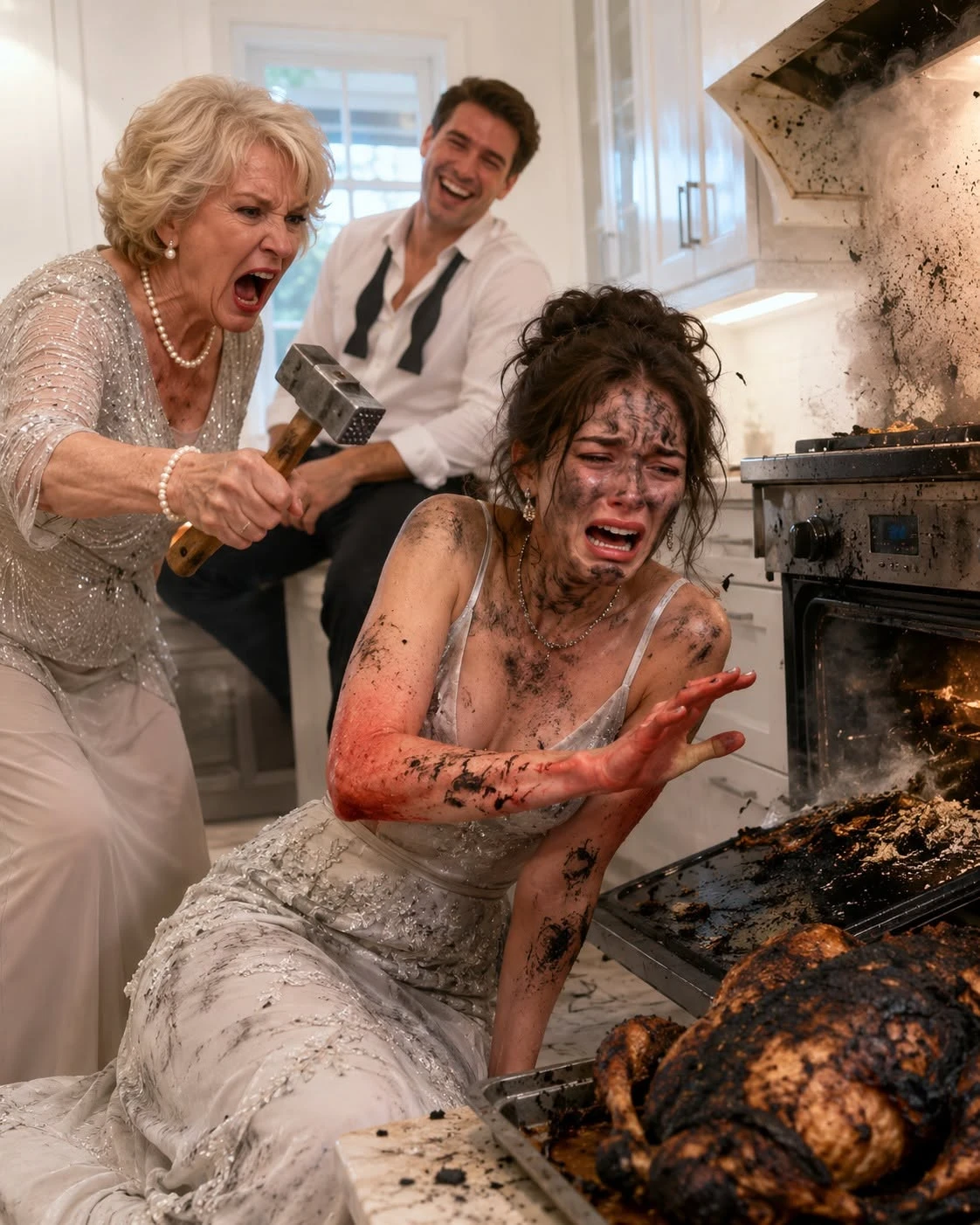
Table of Contents 5
The first thing I understood after the sound was that I had made a terrible mistake.
Not because I had lifted my hand.
Because I had expected mercy.
The cast-iron meat tenderizer came down with a force that seemed to split the room open. A sharp crack echoed through my bones, and for one suspended second, my mind refused to process what had happened. Then pain detonated up my arm so violently that I saw white spots burst across my vision. I collapsed onto the kitchen tile, gasping, my left hand clutched against my chest as if I could keep the damage contained by holding it close enough.
Two fingers already looked wrong. A purple swell was blooming under the skin, spreading fast, ugly and pulsing. I had spent half my life learning how to keep my hands steady under pressure—how to hold a child’s brain still, how to thread a suture through tissue thinner than paper, how to save a life without trembling once.
Now my own hand was folding apart in front of me.
Above me, Barbara stood breathing hard, her chest rising and falling as if she had just completed a workout instead of swinging a weapon at her daughter-in-law. The meat tenderizer was still in her hand.
“That’s for ruining the turkey,” she said.
I stared at her, unable to speak, my ears ringing.
On the table behind her sat a Thanksgiving spread I had not touched in two days because Barbara had insisted I cook it after a fourteen-hour surgery shift. The turkey had burned black in the oven because the temperature had been turned up far beyond what I set. I knew I had not changed it. I knew that with the same certainty I knew the anatomy of the skull.
I turned my head, searching for David.
My husband sat at the table in a sweater I had bought him, calmly cutting into mashed potatoes. He didn’t even look up right away. When he finally did, his expression was one of annoyance, not concern, like I had interrupted something mildly inconvenient.
“Stop crying, Maya,” he said. “You still have your right hand to wash the dishes.”
For a moment I thought my own body might fail me from shock before the pain even finished its job. My whole world narrowed to the sound of my breath and the smell of burnt meat and the unbelievable, blinding knowledge that the two people I had loved most had just shown me exactly who they were.
I had wanted to believe Barbara was just difficult. Loud. Cruel in the way some older women were cruel when they thought the world owed them reverence. I had wanted to believe David was exhausted, passive, trapped in the same house with her. I had defended him to my friends, to my sister, even to myself.
But his fork had not moved. Not once. He had watched me fold to the floor and kept eating.
Barbara crouched, not to help, but to get closer to my face. Her voice dropped into a venomous whisper.
“You think you’re so important at that little hospital,” she said. “But in this house, you’re useless.”
I wanted to laugh. The sound that escaped me was too small, too broken.
That house was not hers. I had paid for it. The mortgage had been wrapped into a trust I’d created before the wedding, back when I still believed legal precautions were only for rich people with suspicious in-laws. The cars in the driveway, the bills, the scotch David liked to pour for himself every night while calling his temporary unemployment a “transition period”—all of it came from my income.
But none of that mattered in the next several seconds. None of it mattered while pain kept climbing my arm and my fingers started to numb in strange, terrifying waves.
“Call 911,” I whispered to David.
He sighed like I had asked him to take out the trash.
“I’m not dealing with this on Thanksgiving.”
Barbara actually smiled. She thought she had won something.
Then my vision shifted, and I saw the pattern I had been refusing to see for months: the locked drawer in their room where David kept my spare keys “by accident,” the missing statements from our shared account, the way Barbara had once stood in my closet and laughed at my work clothes, saying a woman with no children shouldn’t need to come home so tired.
The pain had not gone away. But something else arrived beside it, colder and more useful.
Clarity.
I reached into the pocket of my scrub jacket with my good hand and found my phone. My fingers shook so badly I nearly dropped it. I had to blink through tears to unlock the screen. I called 911 myself.
“Please,” I said when the dispatcher answered. “I’ve been assaulted. I need an ambulance. My hand—”
Barbara snatched the phone from me, but not before the dispatcher heard enough to stay on the line.
David finally set his fork down, irritated now, as if the room were inconvenienced by the presence of a medical emergency.
“You’re overreacting,” he said.
I looked at him from the floor, at the man I had once kissed in a hospital parking lot after a night shift, the man I had supported through law school applications he never submitted, the man whose “job search” had become a two-year vacation funded by my income and my patience.
Something in me went very still.
The sirens sounded first like a rumor, then like a promise.
And while Barbara continued to insist I had done this to myself by “making a scene,” I realized that the wrong thing had not happened to me on Thanksgiving.
The wrong thing had happened for too long before that.
The ambulance arrived within minutes. Paramedics knelt beside me, their voices calm and practiced, cutting through the chaos. One of them gently examined my hand, and the concern in his eyes was immediate.
“Possible multiple fractures,” he murmured to his partner. “Maybe tendon involvement.”
I closed my eyes.
My surgical hand.
My livelihood.
My life.
As they lifted me onto the stretcher, David stood in the doorway with his arms crossed, looking offended that the evening had taken such a dramatic turn. Barbara hovered behind him, already building the lie she would tell later.
But while the gurney wheels clicked toward the front door, I caught sight of the framed document in the hallway—the deed agreement hanging beside the antique mirror. My trust name. My signature. My house.
And for the first time all night, I almost smiled.
Because they still didn’t know what Monday would bring.
Other posts