Chapter 1 - The Girl Who Asked for Leftovers
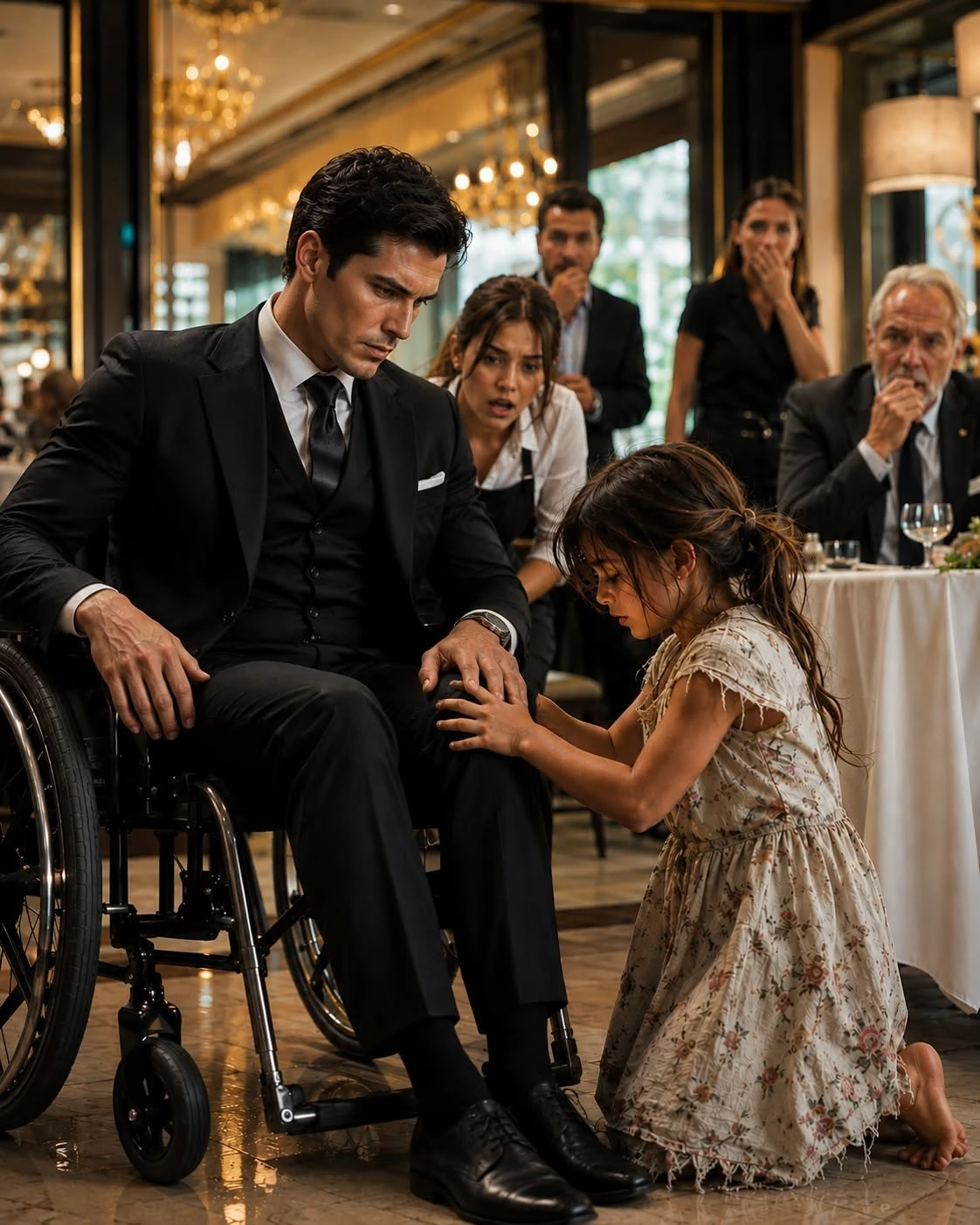
Table of Contents 5
Barcelona looked expensive through the restaurant glass, and I had long ago learned that expensive things could still feel like a prison.
From my table near the window, I watched the city move in golden streaks outside while my own life remained stuck in one place. The polished marble floor, the crystal glasses, the low music, the laughter from well-dressed diners—it all belonged to a world I technically owned and no longer recognized. Five years earlier, I had been the kind of man who crossed rooms without thinking. Now I crossed nothing. I sat in my wheelchair like a monument to everything I had lost.
María stood beside me with a plate in her hands, her expression stubborn in the way only kind people ever managed.
“You need to eat,” she said.
“I’m not hungry.”
“You said that yesterday.”
“I was honest yesterday, too.”
That almost made her smile, but her eyes stayed sad. María had worked in my mansion for eight years, and unlike the doctors, the lawyers, and my own relatives, she never tried to look brave around me. She never lowered her voice. She never touched my shoulder like I might shatter. That was why I trusted her more than anyone.
She set the plate down anyway. “Then pretend.”
I looked at the food and felt nothing. Not hunger. Not pleasure. Not even annoyance. There had been a time when I had built buildings, signed deals, and filled rooms with men who pretended to admire me. After the accident, after the surgeries, after the endless apologies, I had learned that wealth did not make pain smaller. It only made silence more expensive.
A small voice broke through the quiet behind us.
“Sir… do you have any food left over?”
The restaurant seemed to freeze.
I turned.
A barefoot little girl stood beside my chair, no older than five. Her dress was torn at the hem and too thin for the cold. Her hair looked as if it had been combed by the wind and abandoned halfway through. Her cheeks were pale, her feet red from the pavement, and her eyes were so steady they seemed impossible in a child that small.
Before I could speak, a waiter hurried over, his face tight with irritation.
“Get away from the guests,” he snapped. “You can’t beg here.”
“I’m not begging,” the girl said, her chin lifting. “I’m asking for leftovers.”
A few diners nearby laughed under their breath. The sound cut through me more sharply than it should have. I had heard that laugh before—in boardrooms, in family dinners, in the voices of people who thought helplessness made a person less human.
María stepped between the waiter and the child. “She asked politely. Give me a moment.”
The waiter looked offended that someone in a uniform had challenged him, but María ignored him completely. She reached for the container beside my plate, opened it, and placed it into the child’s hands.
“Eat,” she said softly. “Slowly.”
The little girl nodded once, then sat down on the edge of the chair like she had every right to be there. She ate with care, tiny bites at a time, as if the food might disappear if she moved too quickly.
I watched her and found myself asking, “You came here alone?”
She paused, then wrapped half of the meal in a napkin she had taken from the table. “No. There are two boys near the train station. They’re hungry too.”
María blinked. “And you were going to keep that for them?”
The girl nodded as if that was the simplest thing in the world.
I stared at her small hands. At her cracked lips. At the quiet certainty in her face. She had almost nothing, and still she was dividing it.
“What’s your name?” I asked.
“Lucía.”
“Lucía,” I repeated.
Her gaze dropped, not to my face, but to my legs. To the blanket covering the useless things beneath it.
Then she asked, in that same plain, fearless voice, “What happened to your legs?”
The question should have angered me. It should have reminded me how many times people had asked with pity, curiosity, or professional distance. Instead, it landed like a stone dropped into still water.
“They don’t work,” I said.
Lucía frowned as if considering a puzzle. “Do they hurt?”
“Not anymore.”
She leaned closer, studying me with a solemnity that was almost unsettling.
“Give me food every day,” she said, “and I’ll help you walk again.”
The table beside us burst into laughter. Then another. A man in a dark suit nearly choked on his wine.
“Someone remove this child,” he said. “This is ridiculous.”
Even the waiter looked amused now, as if the little girl had entertained them for free.
I should have dismissed her. I should have told María to take her out before this humiliation got worse. I should have done what I had done for five years: close myself off, become colder than the room, and let the world keep laughing.
But Lucía did not look at anyone else. She only looked at me.
“You can’t make me walk,” I said quietly.
“Maybe not,” she replied. “But God can.”
I let out a bitter breath that might once have been a laugh.
“And if I don’t believe?”
She came closer still, until I could see the small scratches on her knuckles and the exhaustion under her eyes. Then she placed one tiny hand on my knee.
“Then I’ll believe for you.”
Something inside me cracked—not enough to heal, not enough to hope, but enough to feel the impact.
I did not know why I said yes when she asked if she could come back tomorrow. Maybe it was because no one else in years had spoken to me as if my life might still matter. Maybe it was because she had looked at my ruined body with pity and found none there. Only purpose.
She came back the next day.
And the day after that.
Every afternoon, Lucía appeared at the restaurant with the same bare feet, the same torn dress, the same stubborn eyes. She ate half of whatever María saved for her, wrapped the rest for the two boys she kept mentioning, then knelt beside my wheelchair and pressed her hands over my knees. Sometimes she prayed in a whisper. Sometimes she just sat in silence, as if listening for something I could not hear.
The staff mocked her until María silenced them. The diners stared until they became bored. I told myself I was only allowing this because I was curious. I told myself a great many lies.
On the seventh day, the manager came over with a furious face, ready to throw her out.
Lucía did not flinch.
She only placed both hands around my knees again, closed her eyes, and whispered, “Please.”
Then heat flooded my right leg.
Not memory. Not imagination.
Heat.
I sucked in a breath so fast it hurt. A violent spark shot through my foot, sharp enough to make my hands grip the arms of my chair.
“Señor Romero?” María whispered.
I could not answer. My gaze dropped, stunned, to the blanket.
Because beneath it, in the place that had been dead for five years, my right toes moved.
Not much. Not all at once.
But they moved.
The laughter at the table behind us died instantly.
Other posts