Chapter 4 - What Vaughn Hid
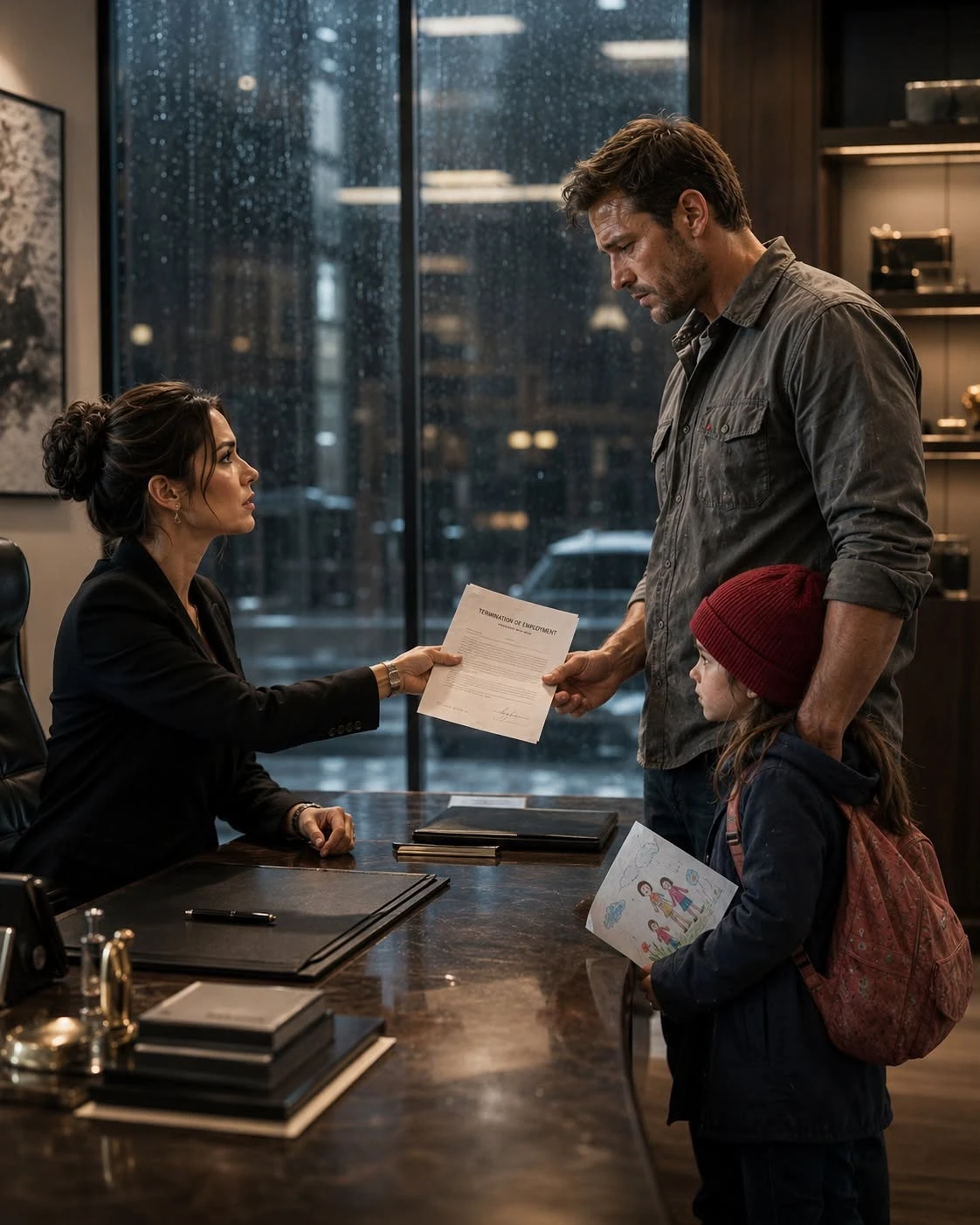
Table of Contents 6
By the time I found Declan again, the rain had stopped, but the city still looked rinsed in gray. He was standing under the awning of a narrow pharmacy two blocks from his apartment building, one shoulder lifted against the wind, Maya tucked close beside him in the kind of wary stillness children wore when they were trying not to make themselves another problem.
I almost didn’t recognize him outside the company walls.
At Lynwood Freight, Declan had looked like a man folded neatly into his own silence. Out here, he looked tired in a way that went all the way down to the bone. His shirt was damp at the cuffs. A paper bag with a pharmacy logo dangled from his hand. Maya’s red knit hat had slid low over one ear, and when she leaned against him, he put a hand over her head with such unconscious tenderness that something sharp and ugly twisted in my chest.
He saw me and straightened at once, as if shame were another job he had to perform well.
“Harper,” he said.
The use of my first name hit harder than I expected. At the office, he had always called me ma’am, even while I was dismissing him. Even while I was making his life smaller in front of his daughter.
“I need you to tell me the truth,” I said.
His mouth tightened. “I already did.”
“No,” I said, too fast. “Not the polished version. The real one.”
Maya looked up at him. “Daddy?”
“Go inside, sweetheart,” he said gently. “Wait by the desk.”
She hesitated, then obeyed, disappearing into the pharmacy with the careful steps of a child who had learned to move around adult trouble.
Declan and I stood under the awning, the smell of wet pavement and antiseptic drifting between us.
“I saw your apartment file,” I said.
His eyes flickered once. Not surprise. Dread.
There wasn’t much to see, and that was the worst part. A second-floor walk-up with peeling paint and a broken mail slot. A stack of bills by the door. A box of children’s medicine on the counter. A folded hospital discharge sheet with his name on it and a series of follow-up appointments circled in ink so dark it looked angry.
Maya had been sick for weeks.
Not the kind of sick that could be handled with one quiet errand and a little patience. The kind that turned every morning into a calculation. Could he afford the prescription this week? Could he miss work if the fever came back? Could he leave her with a neighbor who might not answer the phone if something went wrong?
I finally understood the lateness that had looked like carelessness to me.
It had been triage.
“I should have told you,” he said.
“No,” I answered, and my voice came out raw. “You should have been able to tell me.”
That made him look at me, really look at me, for the first time since I fired him.
“I didn’t want special treatment,” he said. “I wanted a paycheck. I wanted Maya stable. I wanted to keep the one thing I could still control.”
“And the truth?”
He gave a tired smile that wasn’t a smile at all. “The truth was too expensive.”
I felt that sentence land in me like a verdict.
He leaned one hand against the brick wall, and for a second I saw the strain he had been swallowing whole. The man had been forced to choose between honesty and rent, between pride and medicine, between the dignity of a clean explanation and the survival of a little girl who depended on him for everything.
“I thought if I explained,” he said, “someone would decide I was unreliable. Or weak. Or a liability. And this company—” He stopped himself, then corrected in a quieter voice. “Your company doesn’t make room for people like me.”
I should have denied it. I should have said he was wrong.
Instead I remembered the way I had looked through him in my office, the way the board had trained me to reward efficiency and punish anything that looked like interruption. I remembered how easy it had been to call his life an exception I couldn’t afford.
I hated myself for how naturally I had learned that language.
“I found something else,” I said, and pulled the folder from my bag.
He stiffened.
Inside was an older personnel memo I had only uncovered because I’d started asking where his name had gone in the internal archives. It was dated years ago, from before my father’s stroke, before I had any authority at all. A supervisor’s note. A commendation that had been buried under later file reorganizations and stripped from the visible summary.
Declan Whitford, it said, had been praised for helping during an emergency incident involving Ava Whitford. The language was brief, almost embarrassingly brief for what I now knew it represented, but it was there. Proof that the company had once known exactly who he was. Proof that someone had made sure it didn’t stay visible.
Declan stared at the page, and I watched something close to grief move over his face.
“I never kept it,” he said. “I didn’t think it mattered.”
“It mattered,” I said.
He swallowed hard. “Back then, I thought maybe it would. Later, I realized the people who make decisions here don’t really want stories like mine attached to the brand.”
The words should have sounded bitter. They didn’t. They sounded worn thin by repetition.
Before I could answer, my phone buzzed.
One message from corporate legal.
One from the board secretary.
Emergency session. Immediate attendance required. Subject: leadership review.
And there, beneath the polished corporate phrasing, was Vaughn’s handwriting in the margins of my mind: he was moving to take the knife from my hand and turn it on me.
Declan saw my face change.
“What is it?”
I tucked the memo back into the folder, my pulse beating hard enough to hurt. “He’s calling a board meeting.”
Vaughn Pritchard.
He hadn’t waited for the truth. He hadn’t waited for the audit trail to finish speaking. He was going to use the chaos, the frozen shipment, my firing of Declan, all of it, and paint me as the reckless daughter who had endangered the company her family built.
For a second, I was back in my office, watching him lean against the glass with that satisfied little smile.
This time, the smile didn’t scare me.
It made me furious.
“I need to go,” I said.
Declan reached for the folder, then stopped himself. “Harper—”
I looked at him, at the pharmacy bag, at the exhaustion he had hidden behind discipline and silence, and something in me shifted for good.
“I believed performance was the same thing as strength,” I said. “I was wrong.”
His expression changed so subtly I almost missed it.
Not forgiveness. Not yet.
But something less guarded.
I turned toward the street, the boardroom already waiting like a trap with clean carpet and polished water glasses. Behind me, I heard Maya call his name from inside the pharmacy, small and bright and utterly unaware that her father was standing at the edge of losing everything.
I kept walking anyway, folder tight under my arm, because now I knew exactly what I was stepping into.
And I knew Vaughn was counting on me to walk in alone.
Other posts