Chapter 6 - Everything in My Name
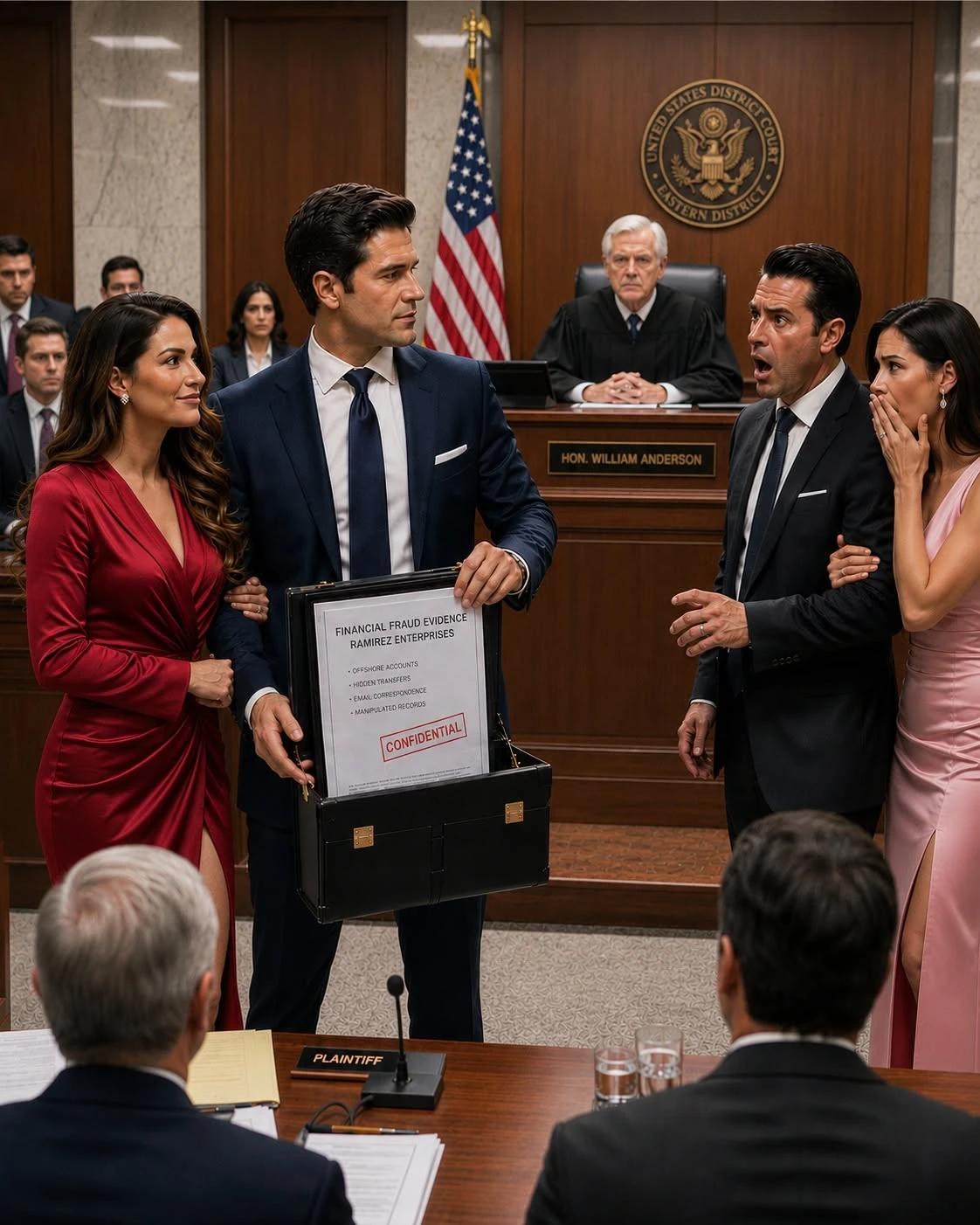
Table of Contents 6
The morning I opened my mother’s handwriting, my hands shook so hard the paper rasped against the edges of the binder.
The envelope had been hidden behind the back pocket seam, flattened flat as if my mother had trusted the future more than she trusted memory. Inside was a single memo page, folded twice, ink slightly faded but still sharp enough to make my chest tighten.
Shared control required. No unilateral authority. Dual sign-off for asset movement above threshold.
I had written those words years ago, late at night at our kitchen table, after warning Eduardo that no company survived on one man’s vanity. Back then, he had kissed my forehead and told me I worried too much. He had even joked that my instincts made me sound like a lawyer again.
Now I understood why that page had disappeared.
He had not just used my work. He had buried the one document that proved he knew better.
Courtroom Four felt different that day. Not colder. Sharper.
Adrian stood beside me at counsel table, calm as stone, while Eduardo sat across the aisle looking thinner than he had the week before. Pamela was there too, but the polish had gone out of her face. She kept glancing at Eduardo like she had finally learned what his loyalty was worth.
Judge Mercer called the hearing to order, and Adrian rose with my binder in one hand and the briefcase document in the other.
He did not waste a word.
He entered the memo first.
Then the transfer record.
Then the metadata from my drafts.
Then Thomas Reed.
Thomas looked like a man walking toward a fire he had helped start. His voice shook at first, but he answered every question. He admitted the backdated approvals. He admitted Eduardo had pushed through transfers into a shell entity while claiming temporary internal authority. He admitted the numbers were hidden from both the court and the company’s outside auditors. And when Adrian asked who drafted the control framework Eduardo relied on, Thomas looked straight at me.
“Marina did,” he said. “Everyone in that room knew it.”
A sound moved through the gallery. Not loud. Just enough.
Pamela broke next, and not because anyone rescued her. Because Eduardo tried to save himself by throwing her under the bus.
“He told me Marina would never fight,” she said, her voice stripped raw. “He said she was soft. He said she’d be grateful to leave quietly if we made her look unstable enough.”
Eduardo snapped her name like a threat, but Judge Mercer cut him off. Pamela did not look at him after that. She told the court about the investor presentations, the minimized role, the way Marina’s name kept getting removed from documents while her work stayed in place. She did not cleanse herself. She simply stopped lying.
When Adrian finished, the room was silent except for the shuffle of papers.
Judge Mercer looked at the memo for a long moment. Then at me.
“Ms. Valez,” she said, “this court finds that Mr. Valez concealed marital and corporate assets, misused internal authority, and acted in direct contradiction to the governance structure the petitioner established.”
My breath caught.
She granted emergency relief, froze the remaining disputed transfers, and ordered expanded review of the company’s ownership records and fiduciary conduct. She did not hand me a fantasy. She handed me back reality.
And reality, for once, was mine.
Outside the courtroom, Eduardo caught me near the marble steps. His tie was loose. His face had gone gray around the mouth.
“You think you won?” he said, low enough that only I could hear.
I looked at him, really looked at him, and felt nothing that could be mistaken for fear.
“No,” I said. “I think you finally got caught.”
His jaw tightened, waiting for me to shrink, waiting for the old Marina who swallowed pain to keep peace. But that woman had stayed in the hallway behind Courtroom Four.
The one standing there now had signed contracts, tracked liabilities, and built a company while he posed for photographs.
“You were never the whole story,” I told him. “You were just the name on the door.”
I walked away before he could answer.
In the weeks that followed, the company changed hands in the only way it could have if truth still meant anything. Regulators moved in. The interim board stripped Eduardo of control. Employees who had spent months terrified by rumors and silence finally got clarity and protection. Thomas kept his word. Pamela disappeared into her own fallout. Eduardo faced civil exposure that no charm and no bluster could wash away.
As for me, I did not go back to hiding behind the man who had erased me.
I accepted the structured leadership role the court and board put in place, but on my terms. I built an ethics and legal operations division from the ground up, because if I was going to return to this world, I was going to return as myself. No borrowed title. No invisible labor. No apology.
A week later, I stood at my mother’s grave with the memo folded inside my coat pocket.
“I found it,” I whispered. “I finally found my voice.”
When I met Adrian afterward, it was not in a courtroom and not under the weight of disaster. We met for coffee, then walked without speaking for a while, both of us letting the quiet do what it needed to do.
He did not rescue me. I did not need rescuing.
He just looked at me with the same steady respect he had shown me in that courthouse hallway and said, “You were never broken, Marina. You were buried.”
That almost undid me.
I smiled anyway.
For the first time in years, my name felt like something I owned instead of something I had sacrificed.
And this time, it was enough.
Other posts