Chapter 2 - A Wife on Paper

Table of Contents 6
The first thing Dominic did after telling me the guard should have been dead an hour ago was take the cuff button from my palm and close his fist around it so hard I thought the metal might cut through his skin.
“Stay here,” he said.
“No.”
His eyes lifted to mine, cold and flat from exhaustion. “That wasn’t a request.”
“It stopped being a request when someone bled in your bathroom.”
For one second, I thought he might drag me back into the bedroom and lock the door again. Instead, something harder passed through his face. Calculation. He looked at me the way a man looked at a weapon he hadn’t meant to pick up but suddenly needed.
“Then you stay beside me,” he said quietly. “And you do exactly what I tell you.”
Downstairs, the mansion no longer looked like a rich man’s home. It looked like a fortress that had just discovered rot in its own walls.
Two guards stood near the front hall with their hands visible. A third man knelt on the marble floor between them, his face bruised, his jacket half torn open as if someone had searched him already. I recognized him vaguely from the chapel. One of the armed men in the back row.
Dominic stopped in front of him. “You entered my house without clearance.”
The kneeling man tried to smile through split lips. “I came to protect you.”
Dominic opened his hand and showed him the blood-specked cuff button.
The color drained from the man’s face.
I didn’t miss that. Neither did Dominic.
“Who sent you upstairs?” Dominic asked.
“No one.”
Dominic gave a soft, humorless laugh. “Wrong answer.”
He crouched in front of the guard, not dramatic, not loud. That made it worse. Men like my father used volume when they wanted to scare people. Men like Dominic didn’t need it.
“What were you looking for?” Dominic asked.
The guard’s breathing changed. Fast. Shallow. “I heard movement.”
“In my bedroom?”
Silence.
Dominic’s voice dropped even lower. “Who checked the chapel records?”
That landed harder than the cuff button. The guard jerked, and that tiny reaction told me more than a confession could have.
Someone had gone back to the chapel.
Someone cared about the exact timing of our marriage.
The guard swallowed. “I don’t know what you mean.”
Dominic stood. “Take him to the east room.”
One of the other guards grabbed the kneeling man by the arm. I had no idea what the east room was, but the terror that crossed his face told me enough.
As they dragged him away, Dominic turned to me. “Now you understand why I told you to stay put.”
“No,” I said. “Now I understand that our wedding mattered for reasons you haven’t told me.”
He stared at me for a long moment, then looked toward the staircase as if measuring how much truth the house could survive.
Before he answered, the front doors opened.
A woman in a charcoal suit stepped inside without waiting to be announced. Mid-forties, composed, expensive leather briefcase, the kind of face that had learned how to remain unreadable around dangerous men. Dominic’s attorney from the chapel.
Grace Holloway.
“I came as soon as I got the call,” she said. Her gaze flicked to me only once, but it was enough to make me feel weighed. “I assume she knows something now.”
“Enough to ask better questions,” Dominic said.
Grace set the briefcase on the entry table and opened it. “Then ask them quickly. We have a larger problem.”
She removed a stack of documents bound with black clips. Not marriage papers. Older. Denser. The first page was covered in legal language, trust references, and dates reaching back years.
Dominic took the file, but I stepped closer before he could shut me out of it.
“You said you needed a wife nobody would investigate,” I said. “Why?”
His jaw tightened.
Grace answered for him. “Because a wife changes standing.”
I looked at her. “Standing where?”
“In matters of inheritance, continuity, and protected domestic transfer,” she said. “Your marriage activated dormant clauses tied to certain Russo holdings. If Dominic died tonight as an unmarried man, those assets and records could be challenged internally. Married, with a documented household, they move differently.”
I felt the words like cold water down my back.
So I hadn’t just been purchased as camouflage.
I had been inserted into a legal mechanism.
My eyes dropped to the dates. One notation referred to an amendment prepared months ago. Another referenced debt review filings from just six weeks earlier. I went still.
“My father died four months ago,” I said.
Neither of them spoke.
I looked up at Grace. “My creditors started calling less than a week after his funeral. Too fast for the normal process. Then someone offered to buy the worst of the debt and restructure it. They made it survivable, just long enough to keep me drowning instead of dead.”
Grace’s expression didn’t change, but silence could be as loud as a scream.
I turned to Dominic. “You didn’t just find a desperate woman. Someone made sure I became one.”
His face gave away almost nothing, which by then I understood was not the same as innocence.
“I suspected your debt had been moved with unusual precision,” he said. “I didn’t know by whom.”
“You married me anyway.”
“Yes.”
The honesty of it hurt more than an excuse would have.
Grace closed the file. “Whoever checked the chapel records knows the marriage mattered. That means time is shorter than we planned.”
Dominic reached into his pocket and placed a key in my hand. Heavy brass. Old.
“The office upstairs,” he said. “You wanted truth. Start there.”
I curled my fingers around the key. “What’s inside?”
He looked directly at me. “The wrong drawer will make you a target forever.”
Then he stepped aside.
I went up alone.
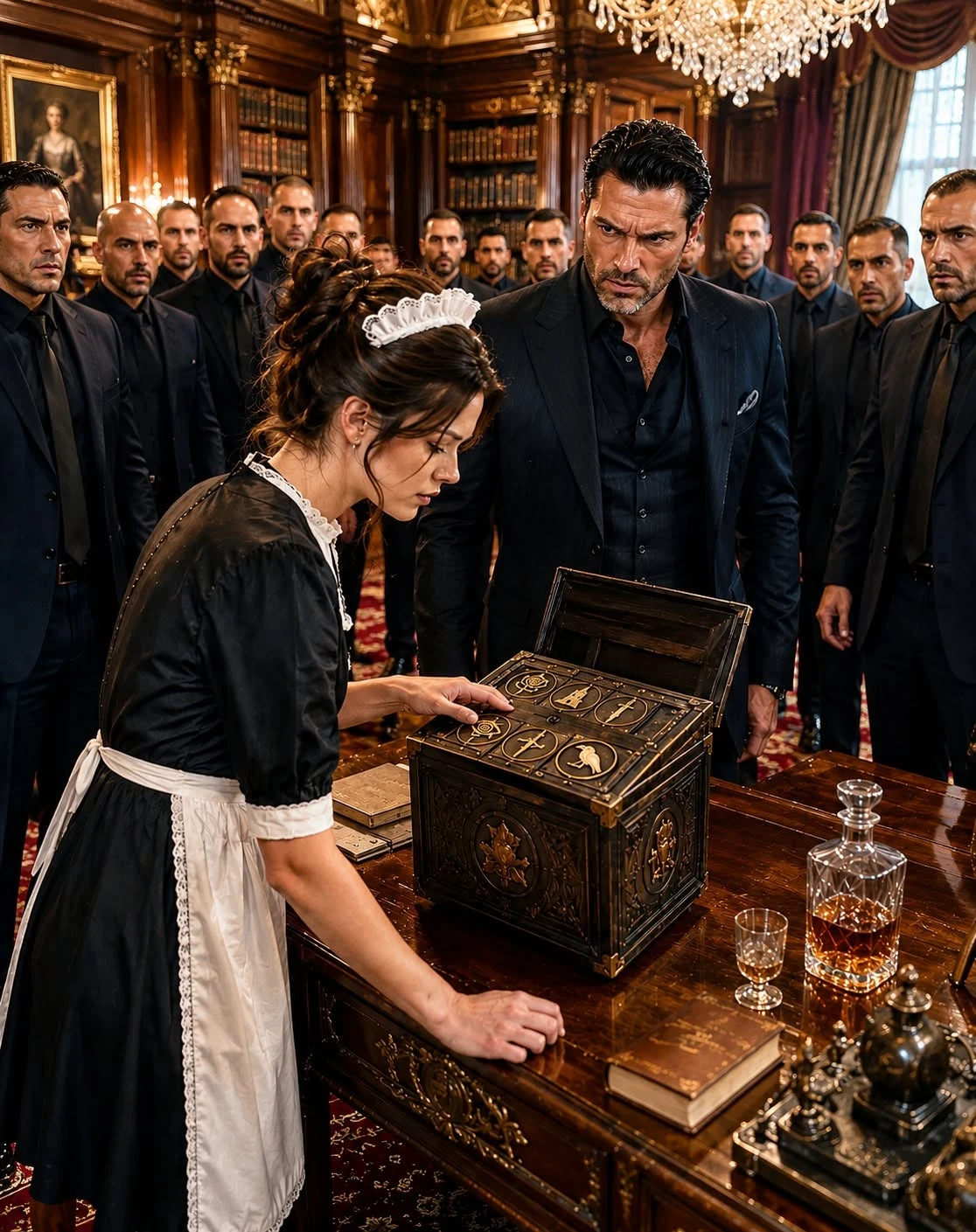
The locked office smelled like cedar, ink, and years of control. Shelves lined one wall. A decanter sat untouched on a side table. The desk was too clean, which meant every object left on it had earned its place.
I moved carefully, hearing my grandmother’s voice in my head: when a room is too orderly, look for what the owner cannot afford to throw away.
The top drawer held contracts. The second held passports and property files. In the bottom drawer, beneath a folder of foundation records, I found a photograph turned face down.
When I flipped it over, the air left my lungs.
Dominic stood in the picture, younger, less carved by sleeplessness. Beside him was another man with the same dark eyes and the same Russo mouth, smiling like the camera had caught him mid-laugh.
Matteo Russo.
Dead men were not supposed to look this alive.
And on Matteo’s wrist, half visible beneath his cuff, gleamed a silver button streaked with a dark speck that looked horribly familiar.
The same kind I had found in Dominic’s bathroom.
Other posts