Chapter 2 - Sophia Had Been Drawing the Same Door for Three Months
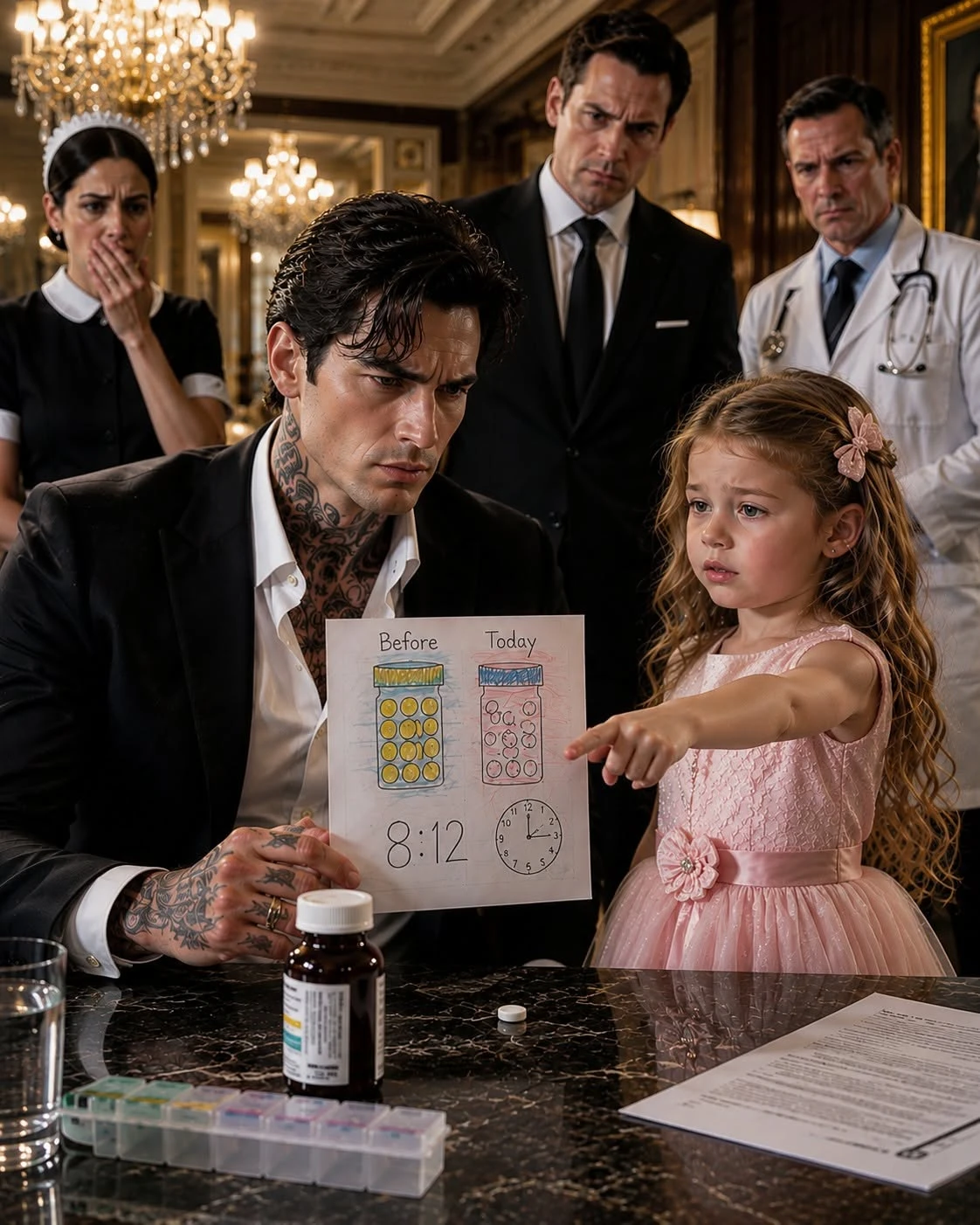
Table of Contents 7
I did not confront Gabriel.
That decision surprised even me.
Twenty years earlier, I would have dragged him into my office, placed the drawing on the desk, and demanded an explanation. Age, illness, and a lifetime surrounded by men who feared me had taught me something useful: frightened people often lie because they think truth has become dangerous.
So I asked Gabriel to sit.
Sophia’s drawing remained inside a folder.
“Where were you on October seventeenth at 7:46 in the evening?”
He stared at me.
“That’s three months ago.”
“I know.”
Gabriel thought for a moment, then said he was probably doing his evening security walk. I asked whether Victor had ever requested that he accompany him near the pantry or medication storage.
His expression changed.
“Yes.”
That answer came too quickly to be invented.
He explained that several months earlier, Victor told him one of the kitchen employees might be stealing expensive wine and medication from staff storage. Gabriel accompanied him through the service corridor twice while Victor checked locks.
“Did he open my medication cabinet?”
Gabriel’s face went pale.
“He said he was checking whether the master key worked.”
I showed him the drawing.
Sophia had placed Gabriel near the doorway because that was exactly where he stood.
He was not helping Victor tamper with anything.
He had been used as cover.
That realization hit Gabriel hard. Victor had practically raised him inside my organization. When Gabriel’s father died, Victor paid for his schooling and later recommended him for security work. If Victor was guilty, Gabriel’s loyalty had been manipulated almost as completely as mine.
Then Sophia showed us another pattern.
She had drawn the same small gray door seven times.
It was located at the end of the service corridor, behind the old wine room. Officially, it opened into a utility closet containing electrical panels and cleaning supplies.
Sophia called it “Mr. Victor’s quiet room.”
Elena immediately became uncomfortable.
I asked what she knew.
She admitted Victor sometimes entered the closet and remained inside for twenty or thirty minutes. Staff assumed he was making private calls. Nobody questioned him because Victor had access to every part of the property.
We searched it.
At first, nothing looked unusual.
Shelves.
Cleaning products.
Electrical panels.
A folded ladder.
Then Gabriel noticed scratches along one section of wall.
Behind a removable panel was a narrow locked compartment.
Victor’s key ring opened almost everything in the estate, but that lock was not part of our system.
Gabriel forced it.
Inside were three prepaid phones, a small laptop, copies of my medical records, photographs of prescription labels, and a notebook containing dates.
Each date corresponded with one of my dizzy spells.
There were dosage notes.
One quarter.
One half.
Full.
My pulse seemed to slow as I read.
Victor had not simply decided to poison me one night.
He had been testing me.
Adjusting.
Learning how my body reacted.
The final pages contained something even worse.
A printed draft of a press statement.
Alessandro Moretti, respected businessman and philanthropist, died peacefully at his Chicago residence following complications related to a longstanding cardiac condition.
My death had already been written.
Gabriel swore quietly.
Elena leaned against the wall.
Sophia stared at us, confused by why adults had suddenly become frightened of paper.
I closed the notebook.
“Take her upstairs.”
Before Elena could leave, Sophia pointed toward the bottom shelf.
“There’s another one.”
Another what?
She crawled down and pulled out a thin blue folder that had slipped behind several boxes.
Inside were copies of letters.
All addressed to me.
Most were unopened.
The first was dated four years earlier.
The handwriting belonged to my daughter.
Lucia.
I had not spoken to her in six years.
Our last conversation ended with her accusing me of choosing power over family. She moved to Seattle, changed her number, and according to Victor, refused every attempt I made to reconcile.
I believed him because Victor handled my private correspondence when security concerns were involved.
Now I held a letter Lucia had written less than two months after leaving Chicago.
Dad, I’m still angry, but I don’t want this to be forever. Call me when you’re ready to talk without sending Victor.
There were twenty-three letters.
Birthday cards.
Photographs.
Updates.
An engagement announcement.
A letter telling me I had a grandson.
My knees weakened.
For six years, I had believed my daughter wanted me out of her life.
She had been writing.
Victor had been intercepting everything.
One photograph showed Lucia holding a little boy around four years old.
On the back she had written:
His name is Matteo Alessandro Chen. I know you’ll pretend you hate the middle name.
I sat down on an overturned bucket.
The betrayal had suddenly become larger than murder.
Victor was not only preparing my death.
He had spent years emptying my life before killing me.
Isolating me.
Making sure the people who might question him stayed far away.
Gabriel asked why.
I looked at the medical files, the hidden phones, Lucia’s letters, and Sophia’s crayon drawings spread across the floor.
“I don’t know yet.”
Then one of the prepaid phones began ringing.
Nobody moved.
The screen showed no name.
Just a number.
Gabriel looked at me.
I answered.
A man’s voice said, “Victor, the documents are ready. Once Moretti goes down, we transfer everything before the daughter can contest it.”
I remained silent.
The caller continued.
“Victor?”
I finally spoke.
“Wrong man.”
The line went dead.
But we had heard enough.
My death was only half the plan.
The other half began afterward.
Other posts